On The Subject of Sentimentality
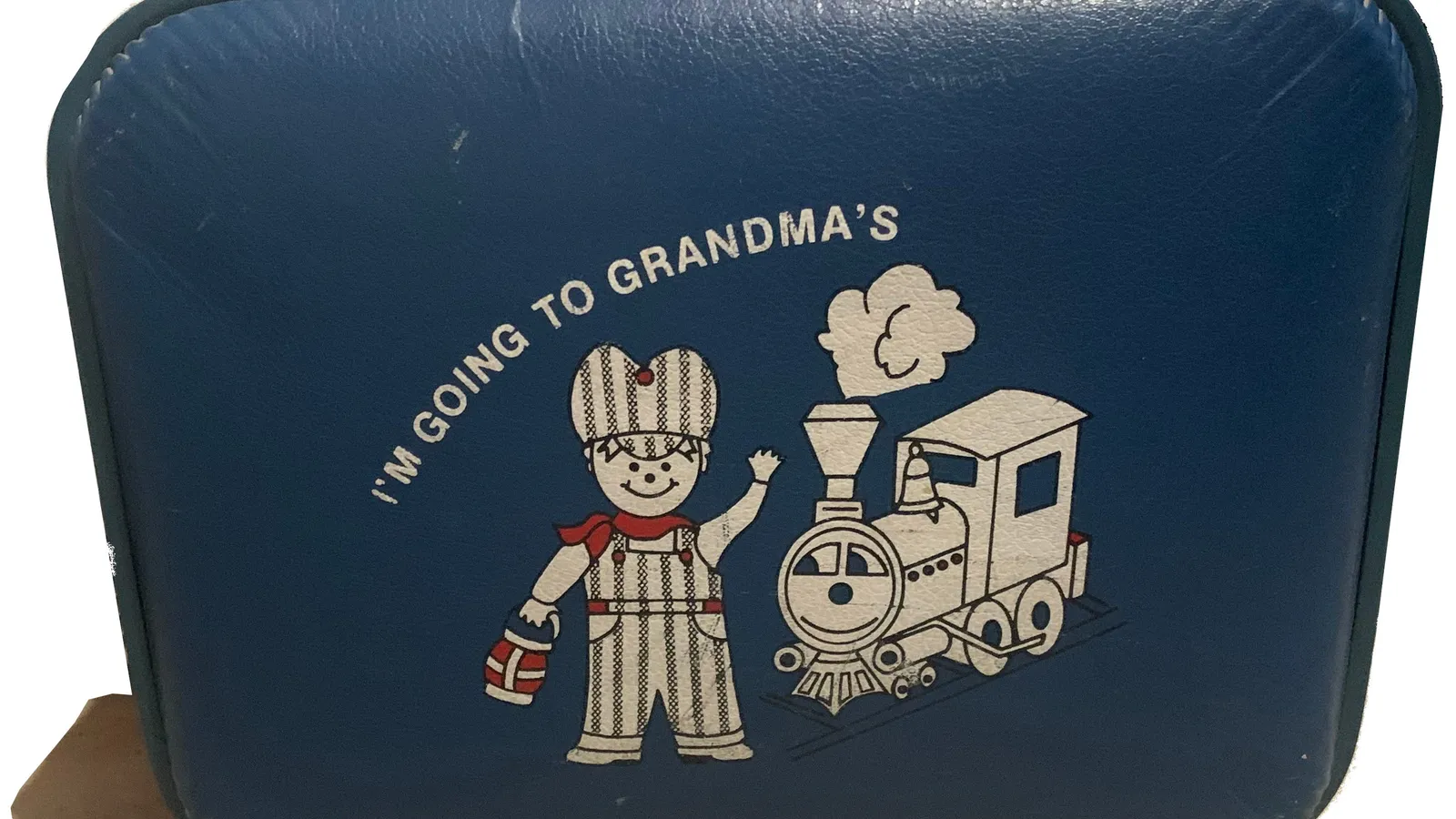
When I was 5 years old, my parents gave me the blue suitcase pictured above. As a 5-year old, it was a prized possession. We made a regular practice of staying with my mom’s sister — who never married nor had any children of her own — on weekends. Well into my teenage years, I used this little, blue suitcase to pack my clothes for the overnight stay with our favorite aunt. (I know, you’re not supposed to have favorites, but I spent orders of magnitude more time with this aunt than any other.)
Also well into my teenage years, I was passionate about animals. As a young boy I wanted to be a Zoologist — probably even before I could spell the word “zoo”. My parents subscribed to the Zoobooks magazine for me; a new issue would come every month.
That blue suitcase became the home for my Zoobooks. As I grew into adulthood, that blue suitcase and those Zoobooks moved with me from house to house.
When my oldest son was born, we occasionally pulled out one of those old Zoobooks. He was never that interested. Fast forward a few more years; my youngest son is every bit the animal lover that I was as a child. We’ve read the same National Geographic “Animals of the World” book so many times the binding is starting to fall apart.
This morning, after carting those Zoobooks around in my little, blue suitcase for more than 35 years, I unpacked them so I can start reading them with my youngest son. I decided to remove the Zoobooks from the suitcase to make them a little more accessible. I stacked them neatly on a shelf, and for the first time in 35 years I considered — just for a moment — tossing the blue suitcase. Instead, I decided to put it on a shelf.
I’m not generally a sentimental guy. For the most part, I discard anything I haven’t touched in a more than six months. If it’s still useful, it goes to the local thrift store. If not, the trash.
Stepping into the macabre for just a moment, I know I’ll die someday and I know I can’t take any of it with me. It’s the same story for all humanity. Someday, we all die, and we leave it all behind.
So, why does that suitcase and those Zoobooks hold sway with me?
Why would I contemplate keeping a little, old suitcase that doesn’t really serve any practical purpose?
Why, after a moment’s contemplation, did I choose to keep both the suitcase and the Zoobooks?
Why are we sentimental? Why do we assign value to things that really have no intrinsic value?
The internet — ever the critic — somewhat harshly defines sentimentality as excessive tenderness, sadness, or nostalgia, where nostalgia means a sentimental longing or wistful affection for the past, typically for a period or place with happy personal associations.
“Wistful affection for the past.” I like that phrase.
Recently, the following statement in a not-so-recent-but-still-applicable article written in by Association for Psychological Science caught my attention:
Research suggests that nostalgia can promote psychological health. Inducing nostalgia in a group of study volunteers resulted in overall positive feelings in this group, including higher self-esteem and an increase in the feeling of being loved and protected by others. Recent work has also shown that nostalgia counteracts effects of loneliness, by increasing perceptions of social support. In addition, that same study found that loneliness can trigger nostalgia.
While I hate to get too quote-y, another paragraph from the article bears repeating here:
Another important function of nostalgia may be in providing a link between our past and present selves — that is, nostalgia may provide us with a positive view of the past and this could help to give us a greater sense of continuity and meaning to our lives. The researchers surmise that nostalgia may also acquire greater significance in old age — elderly adults are especially vulnerable to social isolation and nostalgia may help them overcome feelings of loneliness.
Nostalgia is most often triggered by a sound (like a favorite childhood song), a smell (Remember how Grandma’s house smelled on Christmas morning?), or an object (my blue suitcase).
For pretty much everyone alive today, we’re living in times without precedent. Most people have never experienced the kind of pandemic that we’re experiencing today, coupled with political and civil unrest (oxymoron?).
The phrase, “increasing perceptions of social support” is of particular importance in an age of physical distancing and social isolation.
Psychologists and neuroscientists will tell us that we idealize those memories. Often, the nostalgia we experience isn’t a single memory but a collection of “filtered memories” that serve a number of functions: it helps us cope with the challenges and pressures of our time; it can help us fight depression and anxiety; it can help alleviate loneliness.
Of course, we can’t live in the past. But, allowing ourselves to remember some period in the past with fondness is actually good for us.
My mother passed away when I was only 14. That’s not a happy memory. However, when I unpacked that little, blue suitcase this morning, I remembered all the times my mother — even when she didn’t feel well — would help me pack for yet another weekend with her sister.
And those are some of my best memories.
Comments