Humans Being vs. Humans Doing

Consider this composite image.
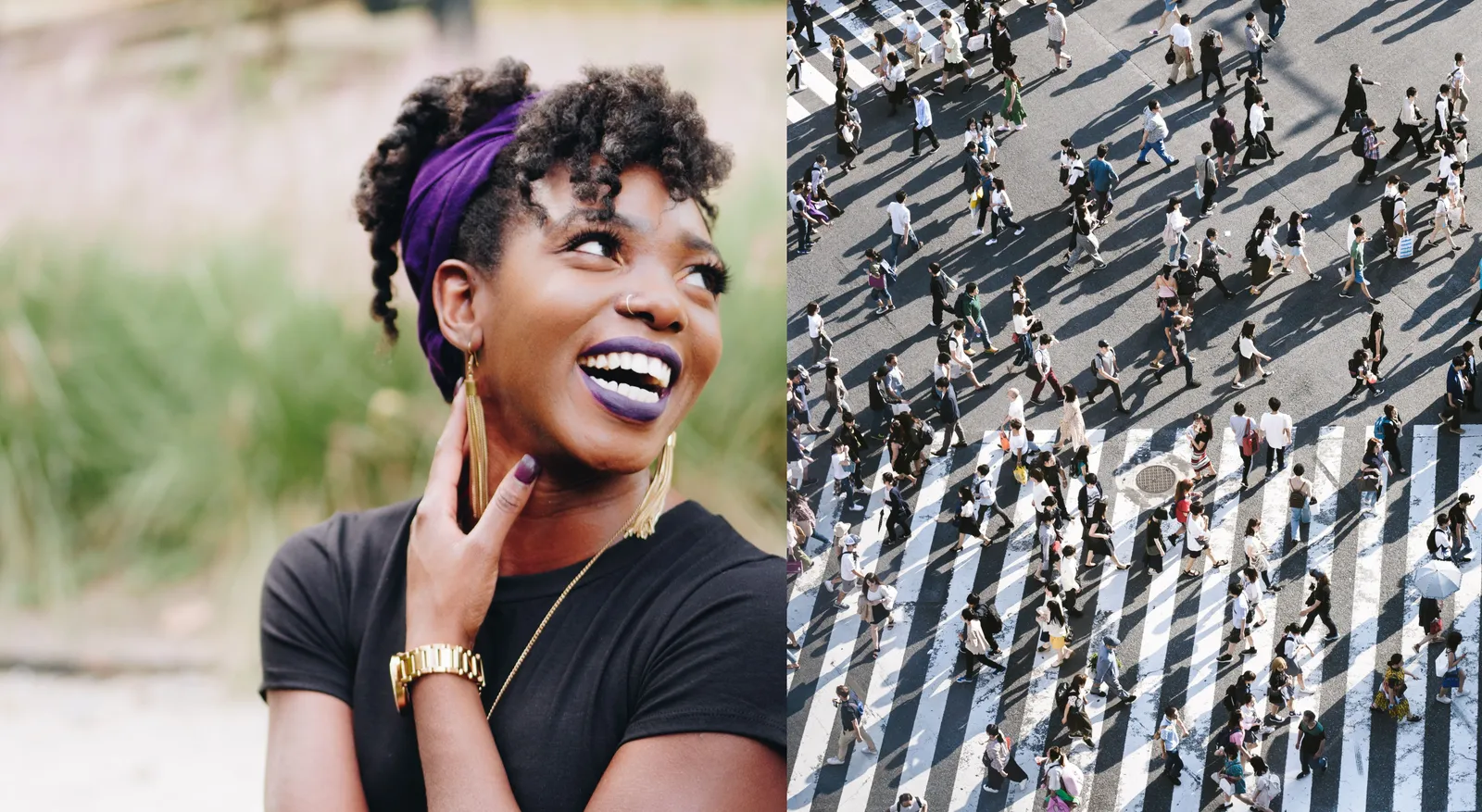
What thoughts and feelings are elicited by the two halves of this picture. Here are a couple of obvious primers:
Eye for Ebony
The image features just one person.
The way her eyes are looking makes me believe she is looking at another person.
The smile on her face indicates she is happy about something.
She is wearing what looks like a nice watch, a gold-colored chain necklace, and nice earrings which lends itself to a measure of affluence, but she’s not rich.
She is beautiful.
The narrative I imagine when looking at this picture is that she is looking at either her best friend or her husband. Perhaps her husband is her best friend.
Because I am in a 20-year old (and counting) heterosexual marriage, I identified her in the same way.
There is humanness in the depiction.
Ryoji Iwata
The image features many people.
The crowd being depicted appears to be multi-national though none of the characters’ nationalities are easily identifiable.
The emotional state isn’t apparent with any of the characters in the image.
With exception of the pair of people at the center of the image, everyone seems bound for some destination.
Some characters’ length of stride seems to indicate they are in a hurry to get where they are going while others have a shorter gait which seems to indicate they are not as rushed to reach their destination.
I see people who are dressed for leisure, blue-collar work, and white-collar work. Several are wearing back packs which may indicate going to school. There is one person holding an open umbrella on a sunny day. The narrative there is they are mindful of taking in too much sunlight. (Aside: I hope you immediately saw my approximate age and cultural bias in the way I identified those dressed for work as white- or blue-collar.)
Which of these two situations do you want more? Do you want to be more like the woman in the “Eye for Ebony” picture or the Ryoji Iwata one? No judgment here. Just curious.
Between the late-1970s and the mid-2000s, the average number of hours worked in the United States by working adults dropped approximately 2% to approximately 34.4 hours per week. Many people reading this won’t believe that statistic because they work far more hours than that.
In a fascinating study called “The Middle Class Time Squeeze” written by Isabel V. Sawhill of the Brookings Institution and Katherine Guyot of Princeton University, they determined, “The average middle-class married couple with children now works a combined 3,446 hours annually, an increase of more than 600 hours — or 15 additional weeks of full-time work — since 1975.” And “full-time dual-earners spend a combined 139 hours per week in total work — defined as market work, home production, childcare, and adult care.”¹
For reference, the first number includes no vacation time which means the average middle-class adult works about 33 hours per week for 52 weeks a year in market work and an additional 36.5 hours per week in home production, childcare, and adult care. There are 168 hours in a week. If we assume 7 hours of sleep per night, the average adult has about 50 hours per week for non-work related activities. That may seem like a lot until you consider commute time (about an hour per working day) and personal preparation (just getting ready for work). Also, consider the fact that the average adult in the US spends 4 hours a day watching television.
The evolution of society is interesting. Even in the hunter/gatherer stage of human history, groups tended to have a leader of some kind — one either self-appointed or appointed by the group. As societies increased in complexity, ever decreasing number of people wielded an increasing amount of power over the lives of larger populations.
According to the Pew Research Center, more than 157 million Americans are part of the U.S. workforce. The same article points out that approximately 16 million U.S. workers are self-employed or roughly 10.2% of the workforce. That means, of course, that basically 140 million Americans work for someone else. 140 million of us (myself included) have given over some control of our time to another person.
The scary thing about this is the situation exists because most Americans spend a large percentage of their income in the pursuit of more stuff. “Keeping up with the Joneses” is a more pervasive problem than ever before. Stay with me. These thoughts will become relevant in a moment.
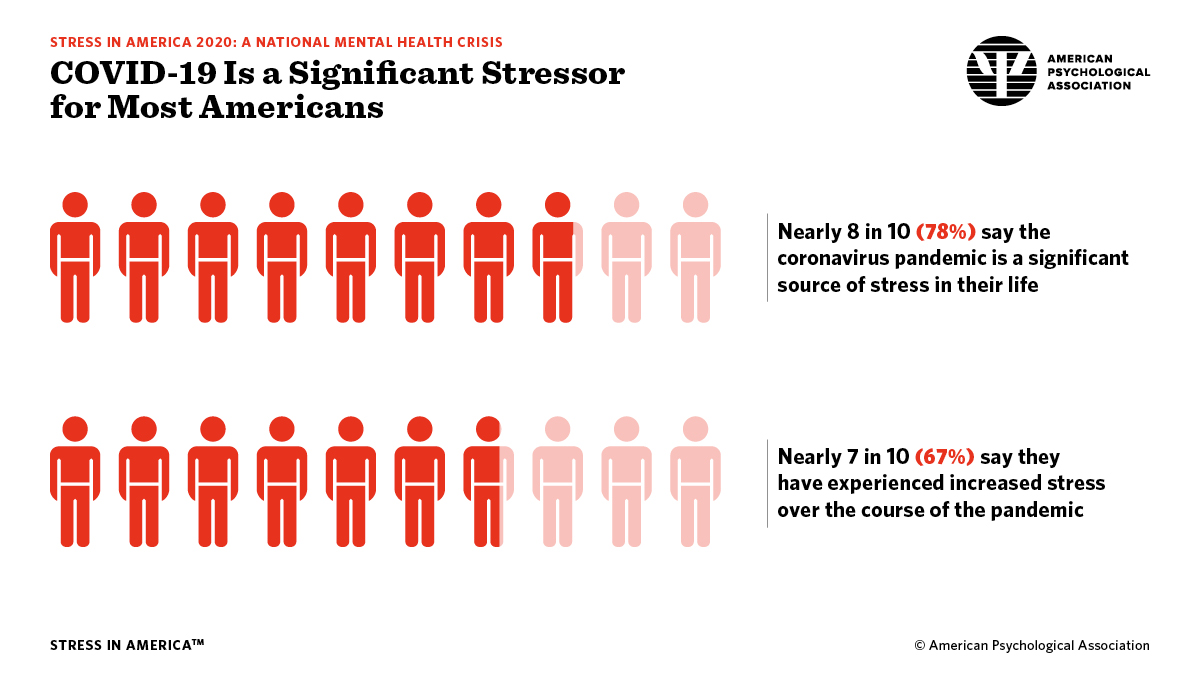
The American Psychological Association (APA) made this argument in an October 2020 article: “Despite several months of acclimating to a new reality and societal upheaval spurred by the COVID-19 pandemic, Americans are struggling to cope with the disruptions it has caused. Nearly 8 in 10 adults (78%) say the coronavirus pandemic is a significant source of stress in their life. And, 2 in 3 adults (67%) say they have experienced increased stress over the course of the pandemic.”²
In an April 2019 article (prior to COVID-19 if you can remember back that far), the New York Times cited a Gallop poll of more than 150,000 people. They discovered that “In the United States, about 55 percent of adults said they had experienced stress during ‘a lot of the day’ prior, compared with just 35 percent globally. Statistically, that put the country on par with Greece, which had led the rankings on stress since 2012.”³
For many of those living in the United States, that stress is not identified as positive. It is stress that leads to anger, frustration, depression, and/or any number of health challenges linked to negative stress. Again, citing the APA, “one-third of Americans are living with extreme stress and nearly half of Americans (48 percent) believe that their stress has increased over the past five years. Stress is taking a toll on people — contributing to health problems, poor relationships and lost productivity at work.”⁴ This study is from before COVID-19 and the numbers are likely significantly higher than this now.
What does it all mean?
Most people in the United States are surrounded by things that are meant to make life easier. Within the middle class, in particular, a pervasive notion exists that upward mobility is desirable and even required. People work more, sometimes laboring for someone else for 12, 14, or 16 hours per day (sometimes longer). The cost of living goes up in a way that outpaces their income so they work even harder.
Even many activities initially designed to promote leisure have become a source of significant stress for adults. Kids who are enrolled in countless extra-curricular activities, many that require significant monetary investments and travel. So, adults must work even harder then spend time chauffeuring their children around to practices, games, and tournaments.
There comes a point when people spend so much of their time working — either for money or otherwise — that they become humans doing rather than humans being.
Humans Doing vs. Humans Being
Becoming a human doing means focusing so much time and attention on labor and money-making activities that we forget to relax and how to play. A human doing is born when the quantity of things to do outpaces the time in which to do them. A human doing is often a person who feels pressured by someone else in an irrefutable way get more done. Whether that is a condition of work done for an employer where increased demands are placed on a person or too many other labor-type activities outside of market work, these are people who have forgotten, in large measure, how to live. Humans doing are often in survival mode.
With each passing year, more people drift from humans being into the category of humans doing; the dystopian future of humans being relegated to mere cogs in a complex machine becomes less science fiction and more reality day-by-day.
Regaining Our Humanity
The realization that we the people built this society is a bitter pill to swallow. Larger government isn’t the answer. I believe smaller government is actually a component to the answer. I believe, however, that the most critical piece to regaining our humanity is within each of us. It is boldly accepting the fact that we don’t need more stuff. It is allowing ourselves to be okay with NOT keeping up with the Joneses. It’s embracing that our home may be a little too small for our family. (With a family of seven people five of whom are rapidly approaching adulthood, I’ve been guilty of this one.) It’s loving that the car I drive isn’t the latest model with all the best features, but that it runs just fine and gets me from point A to point B and back again.
For those of use who have sufficient for our needs and then some, it is also about freely giving of our time and monetary resources to improving opportunities for others. Lifting those who have fewer advantages benefits society as a whole. Interestingly, “volunteering may enhance a person’s social networks to buffer stress and reduce risk of disease. By savoring time spent in service to others, you will feel a sense of meaning and appreciation, both given and received, which can have a stress-reducing effect.”⁵
There is much more to said on this topic of becoming more human being than human doing. For today, consider what you might give up just to spend a few more minutes with your children or serving someone else. I sincerely hope you are in a place where you can see how to make that happen.
End Notes
¹https://www.brookings.edu/wp-content/uploads/2020/08/The-Middle-Class-Time-Squeeze_08.18.2020.pdf
³https://www.nytimes.com/2019/04/25/us/americans-stressful.html
Comments