The Senseless Beauty We Chase
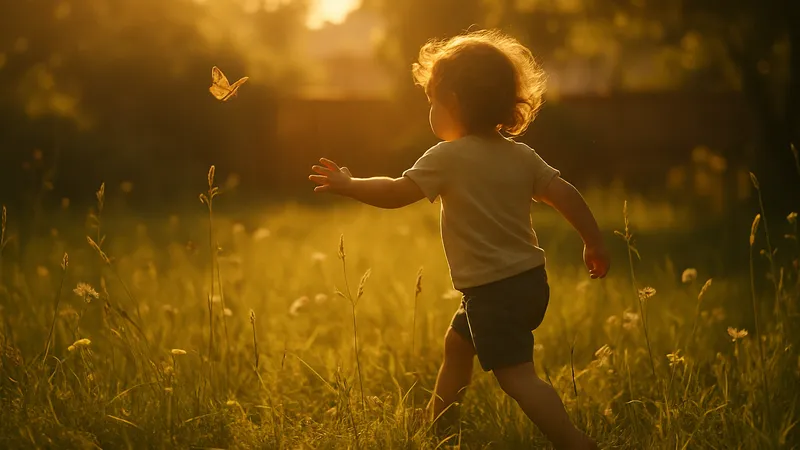
The late afternoon sun caught the tops of the cedar plank fence along the western edge of our yard, laying thin stripes of light across the overgrown grass. My oldest daughter, barefoot, was chasing a butterfly that kept just ahead of her. She called to it, like it might listen, giggling every time it switched directions. I watched from the wicker chair where I was seated, pulling off my muddy shoes, surprised by the stillness of the moment.
I’d meant to mow the lawn. I’d also meant to trim the creeping edges of the flowerbeds. And the raspberries. And the lilacs. I had so much to do, but something about her chase just made me sit there and watch. She didn’t need the grass to be short to feel joy, and she didn’t need crisp, clean edges for the moment to matter.
Lately I’ve been thinking about how much of my life has been spent trying to box in the wild. I can’t walk past my unmade bed without stopping to make it. It’s like I’m trying to tidy things up to the point that I can say, See? I’m doing it right. As if neatness were proof of a life well-lived.
There’s a place in my memory that always comes to mind when I think about that. The International Peace Gardens, tucked into an aging corner of Salt Lake City. My uncle used to take me there when I was young. He lived a few blocks away in a small house that never seemed to change, no matter how much the world around it did.
He was an odd man by most standards — half recluse, half sage. He spoke softly, listened carefully, never married, never chased a career. He didn’t seem to want anything more than what he had: that house, those gardens, and his quiet routines.
I didn’t understand him then. I thought ambition was what made a person real. Now I wonder if he was the only one who had it figured out.
The Peace Gardens weren’t much, just basic flowerbeds representing countries that didn’t always live up to their names, benches with small plaques, winding paths between maples, birches, and aspens. My uncle and I would walk the paths, and he’d tell me stories about the river that ran along the edge. How it carried snowmelt from the mountains, how it curved through the city like a protective arm.
We almost always ended those walks going to our secret place: a small gap in the hedge around the gardens that led to a narrow trail by the river. He’d walk ahead, then disappear, doubling back to startle me and my siblings in the half-dark beneath the trees. We’d laugh, and the moment would fold in on itself like a secret only we shared.
He never seemed to need more than that. When I was a young adult, full of ambition, I thought he was wasting his life with no big plans, no ladders to climb, and no applause to chase. Just walks, conversations, and small, relatively meaningless patches of beauty.
But I see it differently now. Maybe it was never about making sense of the world. Maybe it was about making room for it. Finding the quiet corners where a man can breathe, even if nobody else sees the point.
As a husband, a father, and someone trying to build something real, I still wrestle with that. The urge to prove my worth to clients, to colleagues, and to my own reflection runs deep. I want to show my kids that I can build something solid, something they can be proud of. But standing up straight has sometimes felt more like posturing than progress.
The truth is, I love what I do, but it doesn’t always make sense. Writing, consulting, building from nothing. None of it follows a straight line. The numbers don’t always work, and some days it feels like the effort spills out over the edges.
It’s not logical to chase something that doesn’t always pay the bills or that only you seem to see. But it’s also not logical to plant flowers in a backyard no one else visits. Not logical to carve out time for words when the work that pays the bills is waiting.
And yet, I keep coming back. The garden. The words. The long walks with my uncle. The dinner conversations that stretch into the night. They don’t build an empire, but they make me feel alive.
It’s a kind of senseless beauty, I guess—like a flower that blooms when no one is there to appreciate it. Like a memory of an uncle who never left his neighborhood but somehow lived a larger life than I ever understood.
My uncle died alone in that small house. My aunt found him in the kitchen, the sink still wet from where he’d washed his hair. He was gone, but the kindness he planted in us wasn’t. I think of that often when I wonder whether what I do matters. Because it does. Just not in the ways I was taught to measure.
I’m beginning to believe the real measure of a life isn’t what you produce but what you tend. It’s the messy, beautiful things that don’t make sense but feel essential anyway. The patchwork of conversations, the secret places we share, the hours spent on things that don’t add up but somehow feel complete.
This isn’t an essay about finding an answer. It’s about not needing one. About letting go of the tidy lines and constant striving and remembering that the quiet, senseless beauty we chase is enough. The flowers we plant. The laughter in an unkempt yard. The small, bright moments that don’t need permission to exist.
So I’ll keep tending my unkempt yard. I’ll keep writing, even when it doesn’t pay. I’ll keep chasing the ordinary, imperfect moments, trusting they hold more worth than I once believed.
And that is more than enough.
Comments