Finding Courage to Write a Better Story
When I was younger, I had an almost crippling fear of heights.
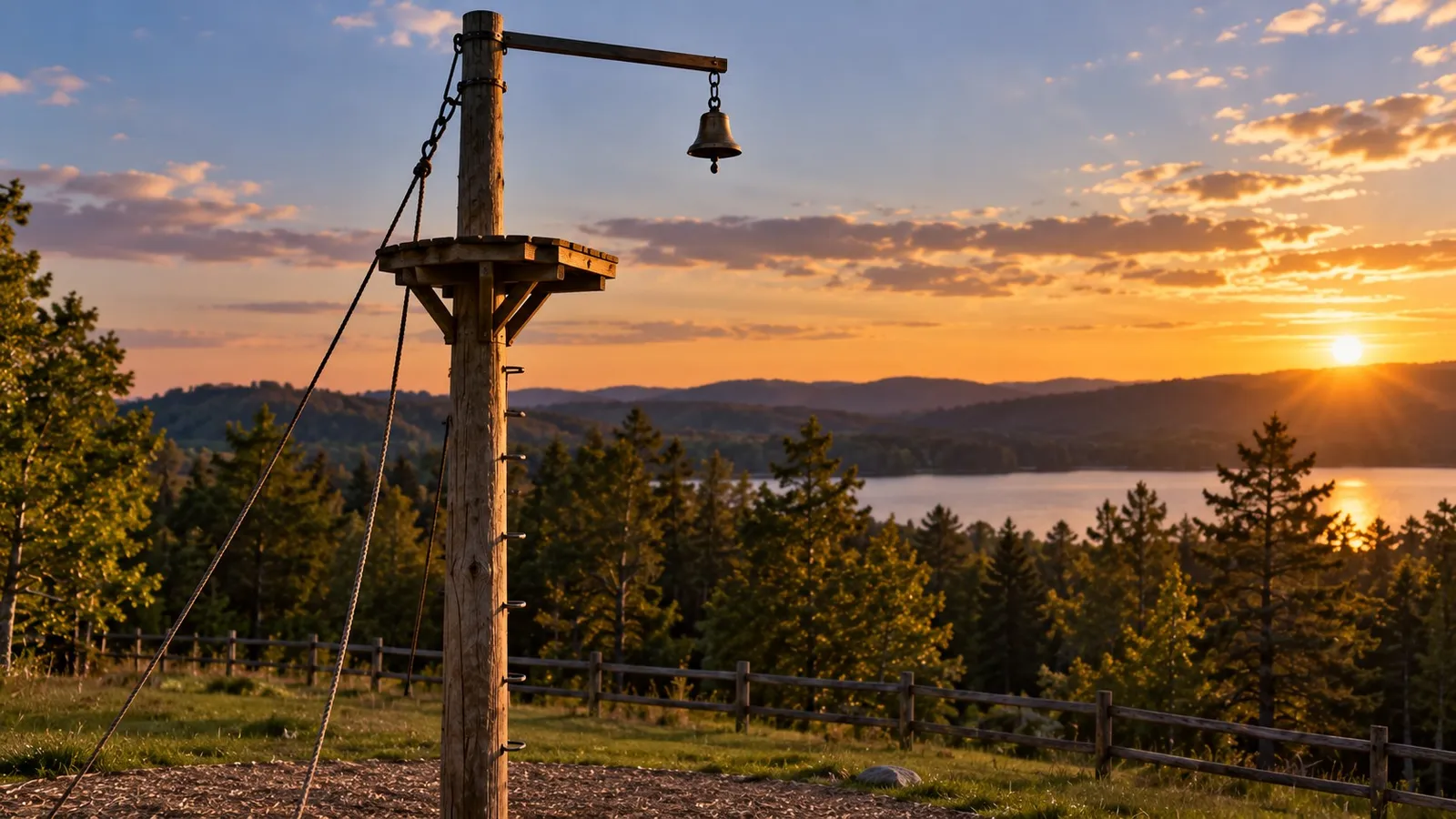
At a Scout camp one summer, my friends talked me into trying part of the ropes course for high adventure. I must have been 14 or 15 years old. One exercise required harnessing up, then climbing to the top of a 20-foot pole crowned with a wooden platform no larger than a large pizza. Once you reached the top, you were supposed to stand on the platform, jump into the air, and ring a bell suspended just out of reach.
I watched my friends do it, one after another. It seemed easy enough, but dread grew steadily as my turn approached.
I was the last one in my group to climb the pole. With each foot higher I went, the paralyzing fear of what I was about to do took over my mind. Somehow, I made it to the platform and managed to sit down, staring at the ground 20 feet below me.
The world spun beneath me, and I was almost certain I was going to be sick.
The leaders who had me on belay encouraged me while my friends shouted that I was a wuss or pansy for not "jumping already!"
I remember feeling like I sat on that pole for hours. It was probably a couple of minutes.
One leader finally invited my friends to "shut the heck up" (I think he might have used stronger language). Then, calmly, he explained that I had four options: I could sit on the pole forever. I could climb back down. I could fall off and let them control my descent to the ground. Or I could get on my feet, jump, and ring the bell.
Four options. And all of them seemed horrible.
Somehow, in my careful evaluation, I determined that falling forward off the platform was my only real choice. Perhaps it was the fact that most of the blood had left my brain by that point.
I did it without warning, catching my belayers off guard, but the two of them outweighed me by a few hundred pounds. My descent was slow and deliberate.
Relief washed over me when my feet finally touched the ground. I wanted to cry, but my friends immediately started making fun of me again until the same leader reminded them how quickly he could kick their posterior regions if they didn't knock it off.
I never rang the bell, but I was back on solid ground, and that was good enough for me.
As I aged, my fear of heights diminished. I still get a little dizzy looking down from great heights, but years in engineering school taught me something about the safety precautions that accompany most activities involving heights. I learned about the strength of materials, the redundancy built into safety systems, and the enormous margins engineers use when designing structures that support human life.
I began to understand the difference between the danger I imagined and the danger that actually existed.
These days, I thoroughly enjoy a high zipline. I love flying, even miles above the ground. There's still an occasional twinge in my stomach, but I've learned to embrace it.
It's funny how our understanding of danger changes as we get older. At 14, I was so afraid of falling 20 feet that I couldn't bring myself to jump, even with two grown men holding my belay ropes.
Now, I'm almost 48, and I've spent much of my adult life doing something considerably more dangerous without giving it much thought.
I've been gambling with my health.
The Risks I Learned to Ignore
There are two "principles" that I've repeated a lot in my life with some measure of belief behind them: "I'll sleep when I'm dead" and "patience is a virtue best held by people with nothing better to do."
For decades, I've worn my ability to function on four hours of sleep like a badge of honor. I'd work late into the night, get up early, and do it all again. Sometimes, I'd keep that schedule for weeks or months at a time. What's remarkable is that I seemed to function pretty well—most of the time.
I built businesses, raised a family with my wife, served in my church, wrote software, solved problems, and somehow found time to run thousands of miles.
In 2023, I was running stronger than at any other point in my life. Twenty-mile runs weren't particularly unusual, and I could maintain an eight-minute-per-mile pace over those distances. I'd come home, shower, eat something, and still have the energy to work in the yard or spend the afternoon doing something with my family.
I didn't even approximate an Olympic athlete, but I was pretty pleased with what my body could do.
Fast forward just three years.
I've gained 30 pounds, and my back hurts almost constantly. My right hip and knee have joined the chorus of complaints. Running a single mile at a 13-minute pace can leave me feeling completely spent. Look, I know that a 13-minute mile is an accomplishment for plenty of people. But for someone accustomed to running 20 miles at an eight-minute pace, the precipitous decline has been difficult to accept.
Somewhere along the way, I stopped exercising regularly. I stopped sleeping enough. I got comfortable with the idea that my body could wait while I dealt with more important things like another deadline or another problem to solve or another person who needed something more than I needed to take care of myself.
I've always felt like I've had legitimate reasons to keep working, but there's trouble with borrowing against your future. Payment will always be due, but it rarely comes right away.
For years, I could ignore the debt because the consequences weren't obvious. But the piper always gets paid.
The Gamble
A few weeks ago, a leader in my church spoke about the dangers of gambling. His message focused on gambling with money and the very real consequences it can have for individuals and families.
I found myself thinking about something else entirely because I realized I've been gambling with my life.
It's not reckless gambling. I wear my seat belt when I'm in a car. I drive most of the time with two hands on the wheel. I don't skydive, and the only drug I'm addicted to is caffeine.
For me, the gambles have been in small, ordinary things that are easy to justify as, well, justifiable.
One more hour at my desk.
One less hour of sleep.
Another week without exercise.
Another meal eaten while working because stopping to eat properly would take too much time.
One more promise to myself that I'll take better care of my body once things calm down.
I don't think I made the deliberate decision that my health wasn't important. Honestly, it's the opposite. I've read enough, studied enough, and experienced enough to know that sleep, exercise, and healthy habits matter. A lot.
Unfortunately, I just keep treating them as things that can wait, and that's the part that's finally starting to bother me.
I knew how to evaluate the structural integrity of a zipline cable. I could examine the forces involved, consider the safety factors, and make a reasonably informed judgment about whether the activity was safe. But when it came to my own body, I seemed perfectly comfortable operating without much of a safety margin at all.
I really never measured for risk. I just assumed I would always be able to absorb it.
For a long time, that assumption seemed reasonable.
Until it didn't.
When Every Reason Feels Like a Good One
The past few years have been difficult.
I left a work environment that was wearing me down and started my own company. We grew, hired people, and built some pretty remarkable software. Then I made financial decisions I wish I could take back. I let expenses run way ahead of available cash, confident that additional investment would arrive in time but it didn't.
During that same season, I cared for a cherished aunt in the final days of her life, watched her pass away, and took responsibility for handling her estate while my business struggled and eventually collapsed.
I found myself doing something I had spent more than a year learning not to do. I became the person who absorbed everyone else's uncertainty.
Now I'm working for three companies to provide for my family while continuing to build software I believe has a future. Some of the people who invested in my company are close friends. Others worked for me through months when there wasn't enough money to pay them.
I feel an enormous responsibility to make things right.
And there are legitimate reasons to keep going. Our products solve real problems. Potential customers are interested. Some of the opportunities we're pursuing could provide the revenue we need to start moving forward again.
So I work. Nights. Weekends. Early mornings.
And when I think about going for a run, getting more sleep, or simply stepping away from the keyboard, there's always a compelling reason not to.
I have people counting on me, and the problem is that I can make a persuasive argument for almost every sacrifice I make.
The next customer could be the one that changes everything. The next feature could be the one that closes a deal. The next few weeks of extraordinary effort could be what finally gets the business moving again.
And perhaps they will.
I don't think these possibilities are imaginary. I have reason to believe in what I'm building.
But I've started to recognize a dangerous pattern.
I keep treating my future health as the one resource I can spend without having to account for it.
I wouldn't run a business indefinitely without looking at cash flow. I wouldn't design a mechanical system without considering the loads it needs to withstand.
Yet, somehow, I am willing to make decisions about my own body based almost entirely on what I need from it today.
Trust me, the irony isn't lost on me. I'm trying to build a future for my family while compromising my ability to participate fully, or at all, in that future.
Four Choices
I'm approaching 50 now. My wife and I joke about getting old—that we're "old people" now. My beard has considerably more white in it than dark brown, and my body cracks and groans when I stand up.
Some of it probably is just aging. Bodies change and recovery takes longer. Things wear out.
But I wonder how often we accept preventable decline as an unavoidable consequence of getting older.
How often do we tell ourselves, "Well, this is just how things are now," when what we really mean is, "This is what I've gotten used to"?
Interestingly, I think that's why I've recently been drawn back to my younger self sitting on top of that pole. I was convinced I was trapped. I couldn't imagine standing up, much less jumping into the air to ring a bell.
And yet, I had four choices.
My leader didn't tell me that my fears were ridiculous, and he didn't demand that I prove myself "a man" by jumping. He also didn't promise that nothing bad could happen.
He simply helped me recognize my options.
Somewhere, somehow, as an adult, I've convinced myself I have only one option: keep working, keep building, keep carrying, and keep promising that I'll take care of myself when there's enough money, enough time, or enough certainty to make it possible.
But I don't think that's true.
I can still work hard without working every available hour. I can honor my obligations without pretending that every obligation must be fulfilled immediately. I can pursue the business opportunities in front of me while accepting that some things may have to move more slowly than I'd like.
And I can start treating my health as one of the responsibilities I have to my family rather than something that competes with those responsibilities.
None of that makes the financial pressures disappear. It doesn't finish the software, satisfy my investors, or pay the bills.
There are real consequences to the choices I make, and I don't want to minimize them, but there are also real consequences to continuing exactly as I have been.
That's the risk I've been far too willing to ignore.
I wish I could tell you that I've figured out how to make all of this work. That I've established the perfect schedule, reclaimed my running endurance, shed the extra weight, and discovered the secret to building a company without sacrificing everything else.
I haven't. Not even close.
I'm still tired. My back still hurts. The work isn't finished, and I still feel the pull to sit down at my keyboard when I know I ought to be doing something else.
But I think I'm finally willing to question the story I've been telling myself for years.
It's the story where the only responsible choice is to keep pushing through the work and the one where taking care of myself can wait until I've taken care of everyone else and the one where I ring the bell, no matter what it costs.
At 14, I didn't have the courage to stand up and jump. I chose to fall forward into the ropes instead. Nobody cheered because it wasn't impressive and because I sat paralyzed on that pole for far too long. When my feet were firmly on the ground, my friends didn't let me forget my "failure."
The fact is, though, I made a choice, and it got me safely to the ground.
Now, 34 years later, I'm re-learning the lesson from the "pizza pole."
I have other options. I don't need the courage to jump higher, work harder, or prove that I can endure a little more.
Maybe it's accepting that I don't have to ring every bell just because there is a bell to be rung.
And maybe writing a better story for myself begins with making sure I'm still around, healthy enough to enjoy the next chapter.
I'm not quite sure what that looks like yet.
But I know I can't stay on this pole forever.
Comments